
A 51& Publication
The Five & One
| The Deep Dive | Our occasional long form |
Every week, we bring you five signals shaping women's health and one thing you can use right now. Because healthcare doesn't fail women for lack of information. It fails because systems are slow to change and rarely built around women's bodies, lives, or timelines. The Five & One exists to make those systems visible.
This Week
This week's newsletter is our occasional long form piece, where we take one topic and go deep. The topic is reimbursement, the hidden system that decides how doctors get paid, and in turn, what care you can actually get.
Sometimes working in women's healthcare feels like screaming into the void. And sometimes you get a signal back. On Tuesday, the federal agency that runs Medicare and Medicaid asked the public for input on how it pays doctors, and specifically on the small committee that has helped decide the value of every medical service for decades. To most people, that sounds obscure. For women's health, it's a door that rarely opens.
This week's edition is not only timely. It carries greater urgency.
Why Reimbursement Matters
If you've ever waited months for an OB-GYN appointment, wondered why your doctor only had a few minutes to spend with you, struggled to get a treatment covered by insurance, or watched a maternity unit close in your community, you've experienced the effects of a system that most people never see: reimbursement.
Reimbursement isn't just about how much a doctor gets paid. It's the financial engine that shapes nearly every part of healthcare, determining what services are available, how hospitals allocate resources, which providers can deliver care, and ultimately, what patients experience every day.
That's why reimbursement has become one of 51&'s critical areas of impact work. Over the past year, 51& has convened leaders from across the broader women's health ecosystem, including health systems, insurers, federal agencies, investors, clinicians, entrepreneurs, researchers, and advocacy organizations, to tackle one fundamental question: how do we redesign the reimbursement system so it better serves women?
Understanding the System
Many people assume insurance companies decide how healthcare is paid for. While insurers certainly play an important role, the system begins much earlier.
How it actually works
A group of 32 doctors makes recommendations about what medical services are worth. The government usually accepts those recommendations. Insurance companies follow the government's lead. Hospitals and doctors then make decisions based on those payments. You feel it when your appointment is 8 minutes instead of 30, or when your local hospital closes its labor and delivery unit.
For those who want the fuller picture, here is the chain step by step:
1. Federal policy establishes the framework for healthcare more broadly, and for Medicare and Medicaid specifically, the large public insurance programs that cover tens of millions of Americans.
2. The American Medical Association (AMA) maintains the CPT codes that define healthcare services and enable billing. Think of these as the catalog numbers for every service a doctor can provide.
3. The AMA's RUC committee, a volunteer panel of 32 physicians and healthcare professionals, makes recommendations on how physician services are valued.
4. The Centers for Medicare & Medicaid Services (CMS) establishes Medicare payment rules and reimbursement rates, relying heavily on those recommendations.
5. Commercial insurers frequently use Medicare as a benchmark when developing their own payment policies.
6. Hospitals and providers make operational decisions based on those reimbursement structures, including which services they can afford to keep offering.
7. Patients experience the downstream effects through access, affordability, and quality of care.
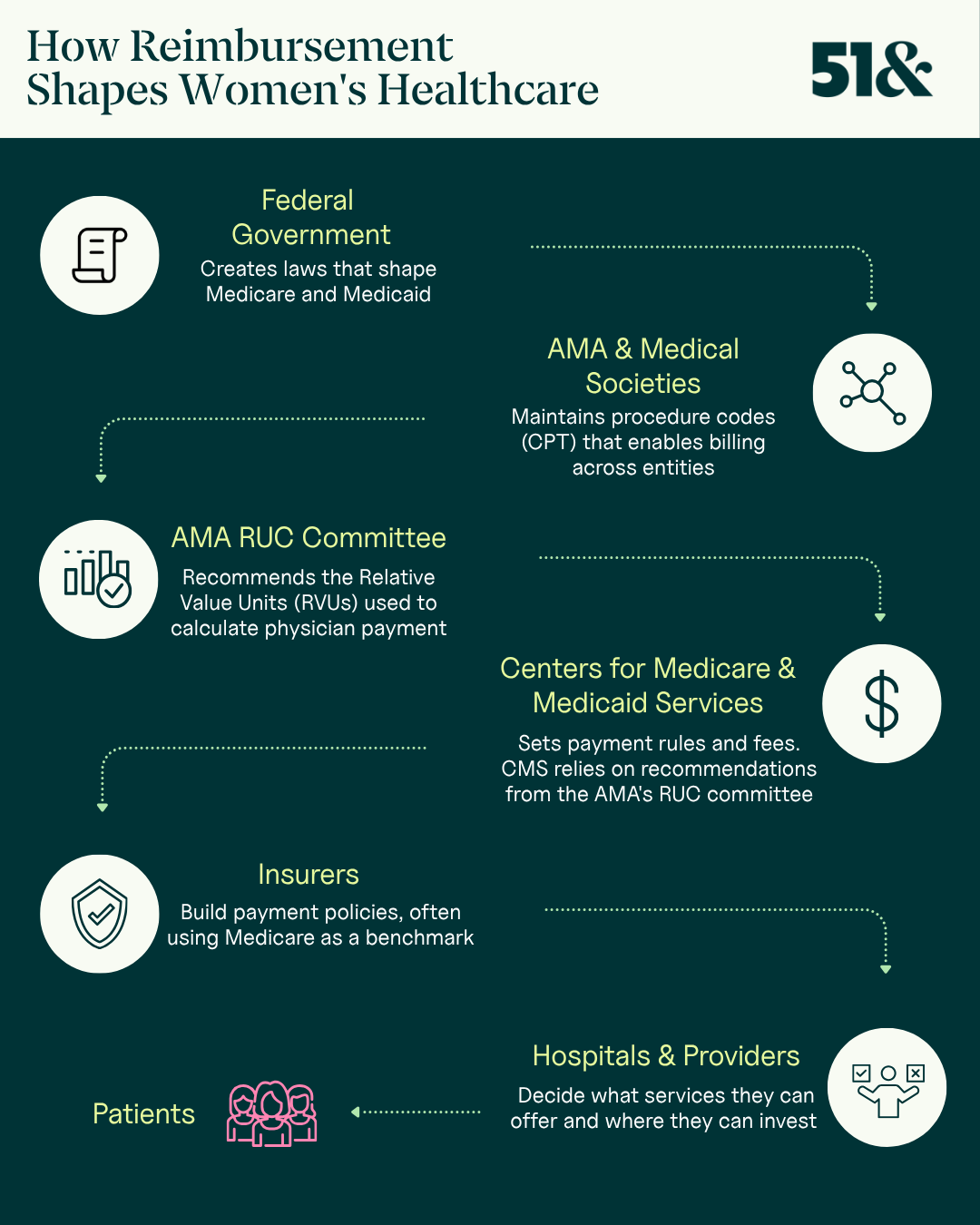
While simplified, this chain helps explain why policy discussions that seem administrative can ultimately influence the care millions of women receive. Those reimbursement rates influence everything from physician pay to hospital budgets. They affect how much time providers can spend with patients, which procedures hospitals prioritize, whether certain specialties are financially sustainable, and even whether rural hospitals can continue offering maternity services.
Reimbursement isn't just an accounting exercise. It shapes how you get care.
Why This Matters for Women's Health
Historically, women's health has been undervalued in numerous ways throughout the healthcare system.
In some cases, when a doctor performs the same kind of procedure on a woman's body as on a man's body, the woman's version is paid less, even when the work is the same. Preventive care, menopause management, pelvic health, endometriosis, maternal care, and many other areas have long faced structural reimbursement challenges that affect both providers and patients.
The consequences are familiar to many women:
- Shorter appointments with doctors
- Long wait times for specialists
- Limited availability of certain procedures
- Closure of labor and delivery units, particularly in rural communities
- Difficulty accessing newer therapies
- Administrative barriers that delay or discourage care
These aren't isolated problems. They're often downstream effects of how the healthcare system values and pays for women's health.
Why the Current Conversation Matters
At first glance, this new government request appears to focus on a small procedural step in a large process.
But the process determines incentives. And in healthcare, incentives influence investment. Investment influences access. And access shapes patient outcomes. When you look at it this way, when 32 people, no matter how accomplished they are, determine how the system functions, it does beg the question: could there be a better way to establish payment benchmarks?
And who sits at the table for these discussions really matters. Representation for women's health relies entirely on a single permanent seat, held by the American College of Obstetricians and Gynecologists (ACOG). Meanwhile, the time doctors spend thinking through a woman's whole picture, counseling her, providing preventive screenings, and caring for her over the course of her life makes up a massive portion of women's primary and reproductive health, and it has historically struggled to be valued fairly.
When women's health services are undervalued, providers may struggle to offer them sustainably. When payment structures fail to reflect the complexity of women's health, patients often feel those consequences long before they understand the policies behind them.
That's why reimbursement reform has become an increasingly important conversation across the women's health ecosystem, and is one of our impact priorities.
Bringing the Right Voices Together
Over the past year, 51& has been convening leaders from across healthcare, including clinicians, researchers, health systems, insurers, entrepreneurs, policymakers, patient advocates, and federal stakeholders, to better understand where reimbursement creates barriers for women's health and where meaningful change is possible.
These conversations aren't about representing a single organization or perspective. They're about bringing together the people who understand different parts of a highly interconnected system and identifying opportunities for collective action.
With this new opening from HHS, 51& is bringing the coalition back together to write a coordinated response, one that puts women's health front and center in a conversation that has too often left it out.
While the policy details are complex, the objective is straightforward: ensure that women's health is appropriately represented in conversations that influence how healthcare is valued and reimbursed.
Looking Ahead
This work is only beginning.
Over the coming months, 51& will publish its reimbursement roadmap, outlining the areas where we believe thoughtful, coordinated action has the greatest potential to improve women's healthcare. We'll also continue sharing educational resources designed to help members better understand the systems shaping care and the opportunities to influence them.
Healthcare systems don't change overnight. Understanding reimbursement is one important step toward building a healthcare system that better serves women. But systems do change through informed collaboration, thoughtful policy, and persistent advocacy. While we still have a long road ahead of us, this is a week where we don't just feel hope. We see possibilities.
The bottom line
• CMS just opened a conversation about changing how doctors are paid
• How doctors get paid shapes what care women can access
• 51& is coordinating the women's health voice in the response
Join Us
If this edition taught you something, that's exactly why 51& exists. The Five & One is free, and it always will be. But the newsletter is just the window. Membership is the room.
51& members get navigation tools to help you find and afford the right care, savings with partner brands built for women's health, member events with the people building this field, and a seat in the advocacy work you just read about. When we submit our coordinated response to HHS, we're not speaking for ourselves. We're speaking for our members.
| Become a Member |
Acronym Glossary
Because healthcare loves an acronym, here's your decoder ring for this edition.
| ACOG | American College of Obstetricians and Gynecologists. The professional organization for doctors who specialize in women's health. It holds the only permanent women's health seat on the RUC. |
| AMA | American Medical Association. The largest professional organization for doctors in the US. It maintains the billing codes (CPT) and runs the RUC committee. |
| CMS | Centers for Medicare & Medicaid Services. The federal agency that runs Medicare and Medicaid and sets the payment rules most of healthcare follows. |
| CPT | Current Procedural Terminology. The standardized codes that describe every medical service so doctors and hospitals can bill for them. |
| HHS | US Department of Health and Human Services. The federal department that oversees the nation's health agencies, including CMS. |
| OB-GYN | Obstetrician-Gynecologist. A doctor who specializes in pregnancy, childbirth, and women's reproductive health. |
| RFI | Request for Information. A formal way the government asks the public and experts for input before making changes. This week's RFI is what opened the door. |
| RUC | Relative Value Scale Update Committee. A volunteer panel of 32 physicians, run by the AMA, that recommends how much each physician service should be worth. |
| RVU | Relative Value Unit. The scoring unit used to measure how much work, expense, and risk a medical service involves. RVUs are used to calculate how much doctors get paid. |
&
PS: We realize a deep dive on how healthcare gets paid was probably not on your summer reading list. But you just made it through nine acronyms and the entire reimbursement chain, which means you now understand this system better than most people who work inside it. If we were the ones assigning value around here, we'd say that's worth a few RVUs.